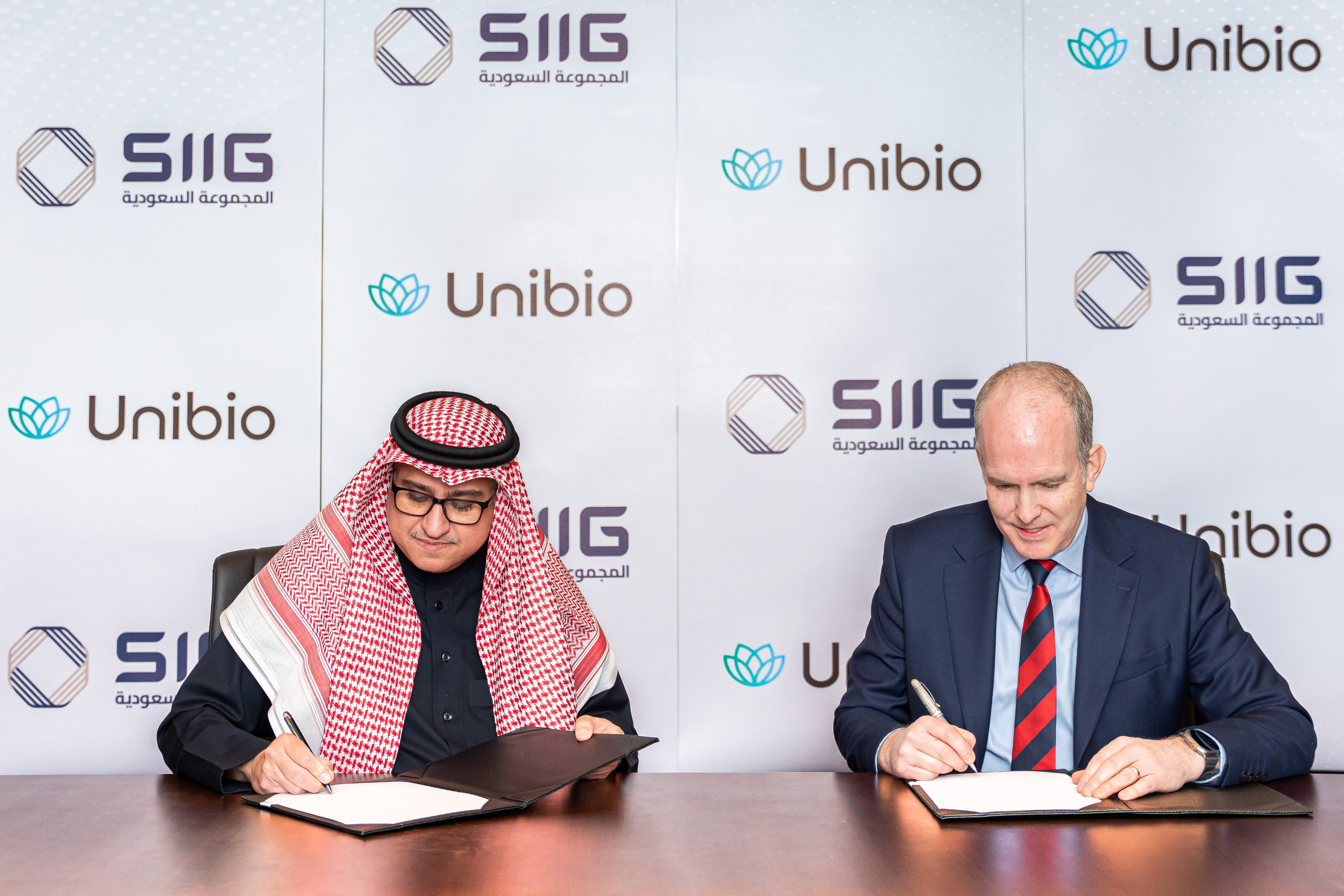
The Saudi Industrial Investment Group and Unibio to build the world’s largest single-cell protein plant in Saudi Arabia
Saudi Arabia approves Uniprotein® for aqua applications

Unibio’s renewed mission and branding signals a new chapter in the journey to transform sustainable protein production

Unibio becomes a member of the LCA institute

Unibio International PLC welcomes a new Board member!
We are delighted to welcome Petter Østbø from Atlas Agro to the Board of Unibio International PLC from 1 March.
Petter, Founder and CEO of Atlas Agro, the renewable fertiliser company, is a distinguished leader in agriculture and business, known for his commitment to innovation and sustainability in the agricultural sector.
He has a track record of managing large-scale production facilities, leading billion-dollar productivity transformations, and advancing sustainable agricultural practices. His strong background in EPCs, projects, project finance and equity finance are areas which will lend strength to Unibio as it grows.
We look forward to working closely with Petter!
Saudi Arabia approves Uniprotein® for aqua applications
Uniprotein®, has been officially approved by the Saudi Food and Drug Authority (SFDA) for use in aquaculture applications. Following a comprehensive review process that began in April 2023, the SFDA has confirmed the safety of Uniprotein® for use in feed for fish, shrimp, and crustaceans. With this approval, Uniprotein® is now cleared for sale to the Saudi feed industry and can be tested under commercial conditions, reinforcing the significant benefits of microbial single-cell protein.
A strategic move into the Middle East
“We are pleased to announce that Uniprotein® has been approved for aquaculture applications in the Kingdom of Saudi Arabia (‘KSA’). This is a significant step into KSA, a key region that is working towards feed and food self-sufficiency under the Vision 2030 programme, while increasing local fish production,” said Olivier Hartz, CCO at Unibio.
Continuously expanding regulatory approvals
Saudi Arabia has joined a growing list of countries where Uniprotein® has been already approved for use in animal feed. The list includes several territories such as the European Union, Japan, India, Thailand, Russia, and Chile. The expanding list of approvals highlights confidence in Uniprotein® as a safe protein source in regulated feed markets.

Uniprotein® featured in Aquafeed.com Magazine’s January 2025 issue
The aquaculture industry stands at a turning point. With innovations like Uniprotein®, we are moving closer to a future where fish farming becomes more efficient, profitable, and environmentally responsible.
In our latest feature article in Aquafeed.com magazine, we discuss how Uniprotein® is setting new standards in aquafeed ingredients.
Find out more about how our gas-to-protein technology is helping the aquaculture sector reduce its reliance on wild-caught fish for feed production.
"This is not just about replacing fishmeal," says Unibio’s Chief Commercial Officer Olivier Hartz. "It's about unlocking the full potential of aquaculture – a sector that can provide a vital source of protein for a growing global population while minimizing its environmental impact. The time for change is now. The future of aquaculture is bright, and Unibio is leading the way."
In the article, we also talk about Uniprotein®'s digestibility, amino acid profile, and immune-boosting properties, which help Atlantic salmon develop a faster and more effective response to vaccination.
Read the full article below:
Aquafeed Magazine Vol 17 Edition 1 2025 by Aquafeed Media
Unibio’s renewed mission and branding signals a new chapter in the journey to transform sustainable protein production
Copenhagen, Denmark, December 16th, 2024 - With the global population expected to reach nearly 10 billion by 2050, the need for sustainable, scalable, and efficient protein solutions has never been more urgent. With a focus on full-scale commercialisation, Unibio has launched a refreshed visual identity. This identity embodies a renewed mission to reshape the future and lead the global shift toward affordable, planet-friendly, and efficient protein production. The ability to deliver enhanced food security without compromising the planet’s resources is a powerful commitment that is enshrined in this launch.
David Henstrom, CEO of Unibio, stated, “By communicating our mission more powerfully, we ensure that Unibio stands out as a leader in sustainable innovation through both technology and product development."
Unibio’s cutting-edge fermentation technology harnesses nature’s alchemy to brew resilient, planet-friendly proteins in a sustainable way, delivering on its vision to transform protein production on a global scale.
The renewed mission and branding mirror a commitment to building a diverse, inclusive working culture that fosters creativity and drives sustainability. A business that operates with purpose, people, and planet in mind and encompasses strong values of collaboration to unlock value, execution with urgency, and empowering ownership.
The development of Unibio’s mission, vision, values, and brand identity has been carried out in close collaboration with Aaron Leaman and the Brighter Future team. Henstrom commented, “His ability to refine and sharpen our message and communicate our story has been invaluable.”

Unibio makes its first ever commercial shipment of Uniprotein® in Europe to Danish Agro
- The first ever shipment of Uniprotein® to a European based customer has been made to Danish Agro, the international agribusiness group
- Uniprotein® is a hiqh-quality, sustainable protein that is made from the microbial fermentation of natural gases, including biogas
- Danish Agro announces that Uniprotein® has proved to be very suitable for piglet feed and will be included in Danish Agro’s feed mixtures as a supplement to protein from potato flour and fishmeal from 15 October 2021
Copenhagen, 6th October 2021 – Unibio, the sustainable protein company, today announced that an initial shipment of 24 tonnes of its groundbreaking Uniprotein® product has been made to Danish Agro, the international agribusiness group, its first commercial customer in Europe. Unibio will deliver Uniprotein® to Danish Agro at an ongoing basis to be a part of Danish Agro’s feed mixtures.
Unibio has developed an innovative continuous-flow microbial fermentation process that uses its proprietary U-Loop® technology and natural gases, including biogas, as the primary feedstock. Uniprotein® is differentiated through its high quality, allowing it to replace products such as fish meal, protein from potato flour, and concentrated soy in feed for fish and animals, such as pigs. The majority of fishmeal is unsustainably sourced, threatens biodiversity and ocean ecosystems. Similarly, global demand for soya threatens further rainforest deforestation and wider habitat destruction. Unibio’s technology enables production of more sustainable protein in very large and scalable volumes to help meet the world’s growing protein needs.
David Henstrom, Chief Executive Officer said: “The shipment of our first commercial order within Europe is an important milestone for Unibio. We have put a lot of hard work into the development of our U-Loop® fermentation technology over the last decade and our Uniprotein® product has now been tested by international compound feed companies with a resoundingly positive response. This is the first time that any single-cell protein has been used as a key ingredient in Danish Agro’s pig feed. We look forward to continuing our collaboration with Danish Agro and increasing our industrial production of sustainable protein to meet the increasing global demand we see.”
Arne Ringsing, Product Manager, Swine, Danish Agro said: “We have been actively looking for a supplement to the conventional protein used in animal feed. We have tested Uniprotein® and it has been shown to be very suitable for piglet feed and will be included in the feed mixtures as a supplement to protein from potato flour and fishmeal from 15 October. We are happy to now be able to use Uniprotein® because it will benefit both the farmers’ pig herds and the environment. There is an ever-growing demand for sustainable protein and Uniprotein® can play an important part in meeting that need.”

Press release: Saudi Industrial Investment Group (SIIG) agrees to invest US$70 million in Unibio
London/Copenhagen 28 March 2023: Unibio International PLC, the leading sustainable protein company, is pleased to announce that the Saudi Industrial Investment Group (“SIIG”) has signed an agreement to invest approximately US$70 million (GBP 59 million) in Unibio. The proceeds will be deployed to enable Unibio’s vision of feeding the world’s growing population in a sustainable way. Unibio will use the funds to roll-out new global production capacity, grow operating capabilities, and accelerate innovation and commercialisation.
Improve the world’s food security
Through industrial protein production based on Unibio’s unique fermentation technology – the U-Loop® technology – it is possible to improve food security and feed the world’s growing population in a sustainable way without use of arable land and with low water usage. The fermentation technology mimics a process that occurs in nature every day and uses methane (e.g. natural gas or biogas) as feedstock. The production of Uniprotein® is efficient, stable, and independent of weather deviations that impact the production of traditional protein sources.
Uniprotein® is approved for feed in the European Union and global registrations are in progress. The protein provides nutrition on par with or better than other high-quality proteinsx, such as fishmeal, and has been tested successfully in various aqua and animal species. Uniprotein® is free from pesticides, fully traceable, and non-GMO. It has been launched commercially and Uniprotein® is attracting significant global interest from feed compound companies and animal and fish farmers. The production of Unibio’s protein for direct human consumption is under development.
David Henstrom, CEO of Unibio commented:
“We are delighted to welcome SIIG as a significant investor in Unibio. Their investment will enable us to play a pivotal role in meeting our customers’ need for sustainable protein. Unibio’s technology will improve food security and speed up the process of feeding the world in a sustainable way. We are pleased that SIIG shares our ambition of providing food security for the world’s growing population and helping stop hunger (#SDG2) and we look forward to working together to make it happen.”
Mr. Abdulrahman S. Alismail, CEO of the Saudi Industrial Investment Group, added:
“We are extremely pleased to invest in Unibio and see it as strongly aligned with SIIG’s new strategy to diversify its investments, enter new sectors focused on sustainability and new technologies, and develop partnerships with international companies. Unibio’s focus aligns with Saudi Arabia’s commitment to increasing domestic protein production and supporting food security through innovation and technology. We are investing in Unibio for the long-term and believe that by doing so we will contribute to a more diverse and sustainable economy.”
The investment in Unibio will be paid in two tranches: the first tranche of approximately US$25 million (GBP 21 million) is paid now with the second subject to applicable Foreign Direct Investment approvals. BofA Securities acted as placement agent to Unibio in connection with the transaction.